UNIJOINTExpansion Joints & Rubber Products
UNIJOINT RJSteel Elastomer Bridge Expansion Joint
Steel / elastomer module bridge deck expansion joint
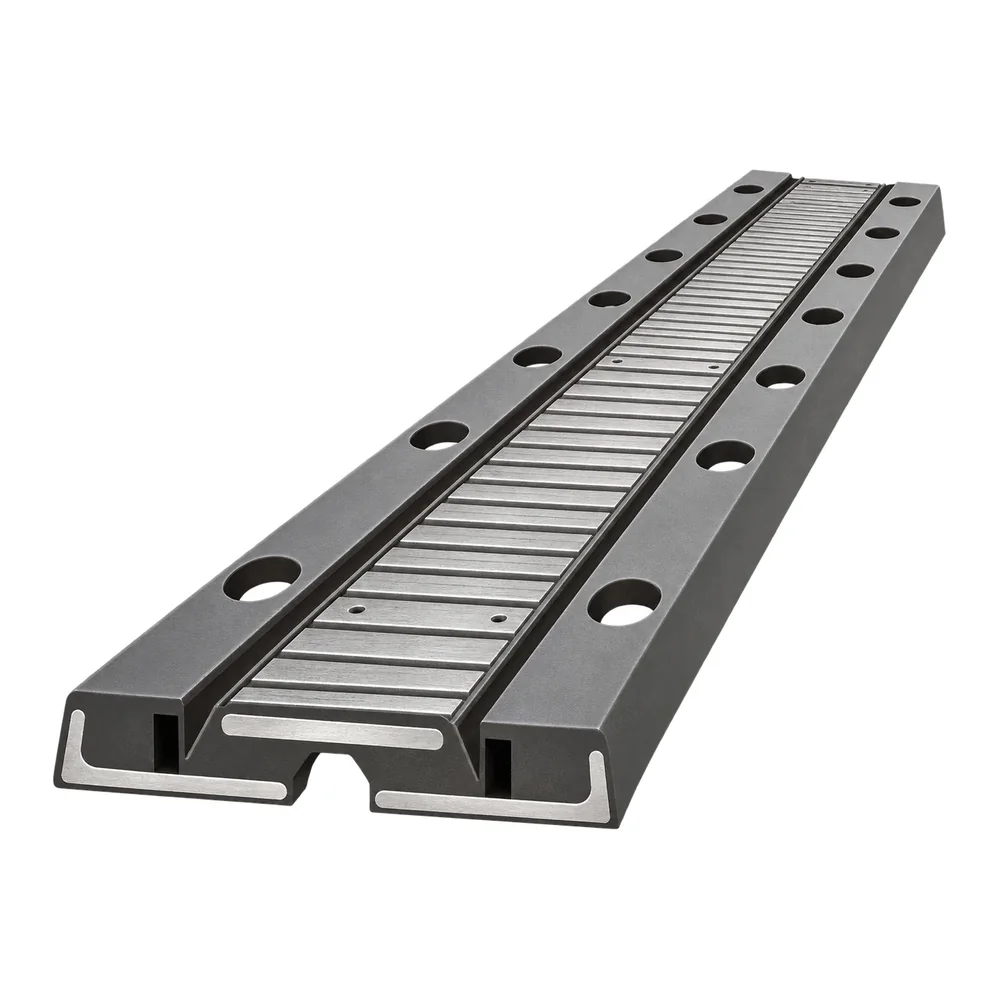
UNIJOINT RJ is a modular bridge deck expansion joint of steel angles and a steel bridging plate fully encased in elastomer, bolted to the deck in module lengths. Seven models take total movements from 50 mm to 330 mm.
- Technical data sheetReadPDF · 1.8 MB
- Drawings & CAD details (5)View & download
- Test report, MSDSOn request
About UNIJOINT Steel Elastomer Module Bridge Joint
UNIJOINT RJ is a modular bridge deck expansion joint made of steel angles and a steel bridging plate encased in a flexible elastomer. It is supplied in module lengths that are bolted to the structural deck on either side of the expansion joint.
Seven models accommodate total movements from 50 mm up to 330 mm, and skew angles can be accommodated. The joint is substantially waterproof and gives a smooth, wear-resistant running surface.
The modules are set between UNISEAL® AP77 nosings on both sides, which form the transition to the premix surfacing.
Advantages
- Heavy duty steel angles and bridging plate for long durability under traffic
- Movement up to 330 mm: seven models from RJ 50 to RJ 330
- Corrosion resistant: steel fully encased in elastomer
- Watertight and anti-skid surface
- Smooth, wear-resistant running surface
- Modular: bolted to the deck; skew angles accommodated
Where it is used
- Bridge deck expansion joints
- Highway bridges and flyovers
- Viaducts and elevated roads
- Bridge joint replacement
Specifications
From the UNIJOINT Steel Elastomer Module Bridge Joint technical data sheet. Check the latest TDS for your submittal.
| Hardness (ASTM D2240) | 60 ± 5 Shore A |
|---|---|
| Tensile strength (ASTM D412) | 15 MPa min. |
| Elongation at break (ASTM D412) | 350 % min. |
| Bond strength (ASTM D429 B) | 7 N/cm min. |
| Compression set (ASTM D395) | 25 % max. |
| Ozone resistance (ASTM D1149) | No crack |
| Abrasion resistance (ISO 4649 A) | 120 mm³ max. |
| RJ 50 | 50 mm movement; 2000 x 274 x 40 mm; M12 studs; 52 kg; 45 Nm |
| RJ 65 | 65 mm; 2000 x 356 x 49 mm; M16; 74 kg; 100 Nm |
| RJ 80 | 80 mm; 2000 x 432 x 52 mm; M16; 96 kg; 150 Nm |
| RJ 100 | 102 mm; 2000 x 590 x 54 mm; M20; 150 kg; 175 Nm |
| RJ 165 | 165 mm; 2000 x 724 x 75 mm; M24; 272 kg; 190 Nm |
| RJ 230 | 230 mm; 2000 x 890 x 93 mm; M24; 375 kg; 275 Nm |
| RJ 330 | 330 mm; 1220 x 1207 x 127 mm; M30; 451 kg; 300 Nm |
| Anchor studs | Grade 8.8, fixed with bonding chemical; spring and oblong washer under each nut |
| Drawing | UR-JT-05 |
Questions about UNIJOINT Steel Elastomer Module Bridge Joint
Which UNIJOINT RJ model do I need?
Select by the total movement the bridge engineer gives: RJ 50, 65, 80, 100 (102 mm), 165, 230 or 330. Each model has its own module width, stud size and bolt torque, listed in the TDS.
How is it installed?
Saw-cut and break out a clean, level recess (module width plus nosing each side), lay levelling mortar on both shelves, drill and fix grade 8.8 anchor studs with bonding chemical, then bolt the modules tight end to end and torque the nuts to the TDS value. Seal the bolt holes and pour UNISEAL® AP77 nosings on both sides.
What goes either side of the modules?
UNISEAL® AP77 nosings, about 100 mm wide typically, poured flush between the module and the premix. Open to traffic only when the AP77 has cooled.
Is it waterproof?
It is substantially waterproof. Where JKR or the engineer specifies, a UNIJOINT rubber sheet membrane is looped into the gap below (see drawing UR-SY-02).
Can it handle skewed decks?
Yes, skew angles are accommodated. Give us the skew, movement and joint length when you enquire.
Drawings & CAD details
3 PDF drawing sheets and 2 editable CAD details (DXF / DWG). Free to download, no sign-up.
Bridge Highway Joint System – 3D
Bridge Highway Joint System
For illustration only – not for construction. Generic product details, not an engineering design. Sizes, reinforcement and installation to be designed and approved by the project engineer. Refer to the TDS.